
Washington called them terrorists, other fighting groups called them their only chance.
An on the ground look at the rise of the Nusra Front Part 2

“Run, there’s a sniper” is enough to get my little legs going as fast as they can and make me wish that I had gone for track and field rather than horseback riding as a teen. It was the sentence de jour in Aleppo back then, whether it was moving through the once bustling alleyways of old city or to get across any road close to the front line.
Most of the families had well cleared out of the area, but we met one that had been living underground for four months. The Kudiye family of five had run out of their home as bombs shook buildings and shrapnel fell around them, sheltering in a carpenters underground workshop. They only left every two weeks to shower. Their home was just five doors down.
“Sometimes its so close this space fills with dust” Zahra, one of the sisters, says as a couple of explosions echo down into the darkness. “We just want to leave. I want to feel the sun, smell fresh air.”
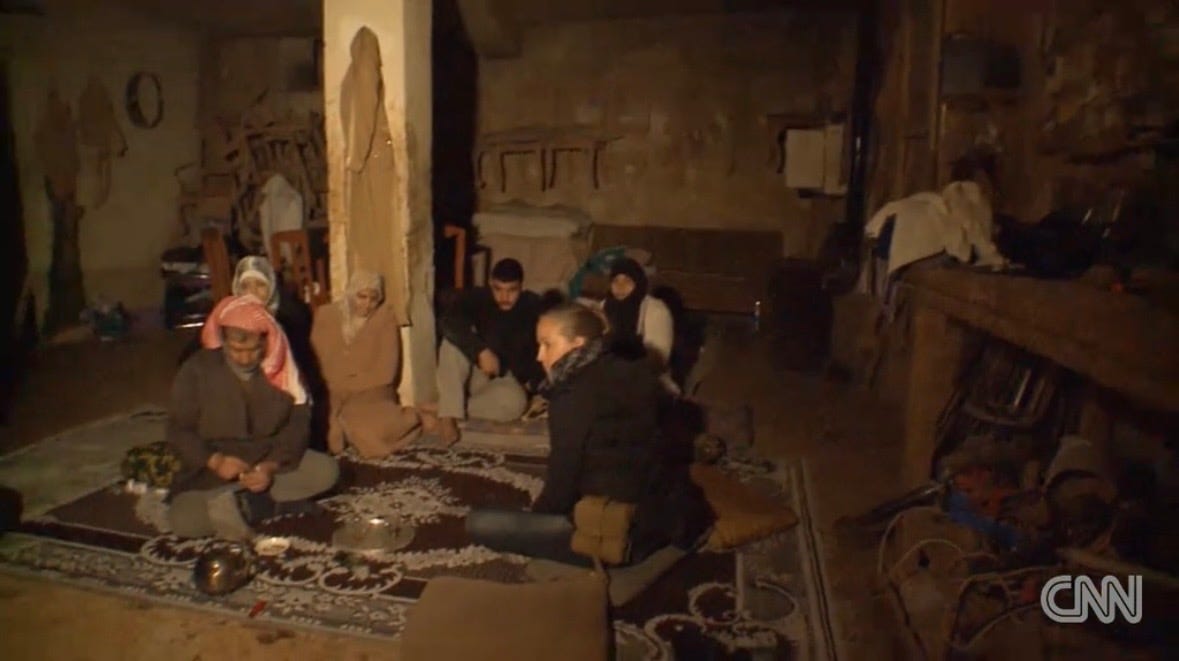
Their father refuses, he’s a proud man and doesn’t want to be at the mercy of others. Here he can send his son out to scrape around for odd jobs and make some money to buy food.
They insist on making us tea. I try to say no thank you, we’re good, you’re so kind. But it’s already served and I notice that they only pour a glass for their father. There isn’t enough for all of them and us.
It’s the end of Nov 2012, and my CNN team and I are in Aleppo. Every corner, every person you meet has a story that shreds your soul. A young man who risked his life to save a stranger shot by a sniper. A mother who has nightmares her children are dead. The muazzin (the person who recites the call to prayer) who uses a low archway in the old city to bounce his voice because his mosque, minaret, and speakers have been destroyed.
There are signs that things might be starting to shift. Led by the Nusra front, a coalition of rebel brigades are assaulting a key Assad military base. As I as described in Part 1 of this series, Nusra’s men were largely former fighters in the Iraq battle space; Syrians who had gone to Iraq, some who joined al Qaeda. Suffice to say, they had plenty of knowledge on how to utilize unconventional tactics coupled with sophisticated military maneuvers.
We had asked about going along on the assault itself, were but in the end were told no, it was too dangerous. I do have a high risk threshold, but I like to think that I’m not entirely reckless. And no, I’m not an adrenaline junkie. Barrel bombs and snipers are enough for me, thank you. I wasn’t all that fussed about not being a part of the “tip of the spear” when I’m with the side that has second hand weapons, no proper comms, and no air assets.
A few days in, we’re given access to one of the units that is holding up the siege on Syrian government forces at the base. Fighting did keep breaking out, especially when a chopper with resupply for the trapped troops would try to drop a load, although they often missed and the rebels would end up with all the food and ammo.
My thighs were already burning from sprinting across an open space littered glass, debris, and spent bullet casings before ducking into the shelter of a small building on the military base. We had hoped that we would get the opportunity to talk to one of the Nusra Front commanders, but in the end that was also a no-go. They were still less than media friendly to say the least.
But we did get a full briefing from one of the other rebel commanders, standing over a printout of a satellite map of the base. The Nusra Front had mapped out the military strategy, collaborating with three other rebel units to launch a multi-prongued attack that left analysts commenting on how sophisticated the assault was and on how Nusra was shifting the battlefield, even though at the time they were estimated to make up roughly 10% of Syria’s medley of rebel units.
The young rebel commander who was briefing us was receptive to the questioning of Nusra’s ultimate goal for Syria and how that fit into other more moderate rebel units broader objectives. The answer was straightforward.
“The U.S. and the West in general have given us next to no help while we’ve witnessed thousands die at the hands of Bashar al-Assad’s heavy weaponry and dominance of the skies.” The commander explained.
“We need them. We have different visions for Syria, but we need their organizational and battlefield experience.”
Having spent time with other rebel units on their frontlines in the city, that need was clear. One unit I was with had a homemade rocket, a rocket launcher that was basically a plastic tube and no sandbags to stabilize it, so it all might as well have been a door weight. They used a sledgehammer to punch holes through the walls of Aleppo’s historic beautiful homes, to create crawlspaces that would allow them to avoid the streets and snipers line of sight.
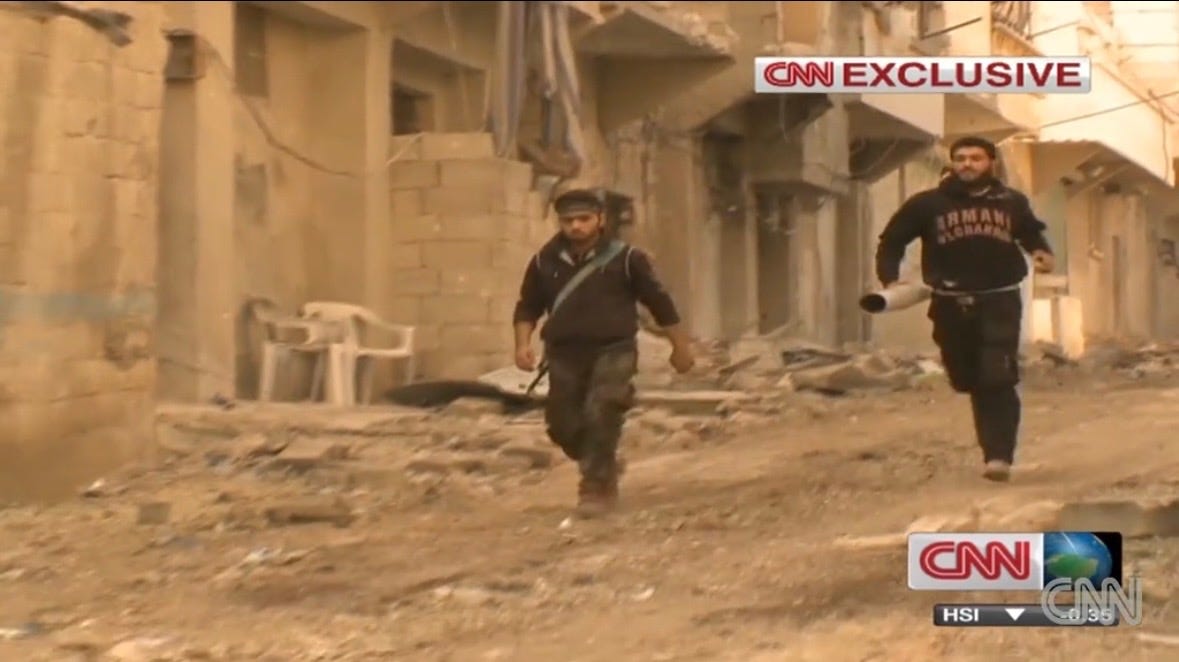
When America designated Nusra a terrorist organization many people were furious.
“America is calling Nusra a terrorist but not Bashar?”
Roughly 12 years later, the Assad regime would fall and the man who established the Nusra Front, Abu Mohammad al-Jolani, would become the President of Syria, Ahmad al-Sharaa. Over the course of those 12 years, Nusra would fight and lose against ISIS, cut ties with al-Qaeda, re-brand itself numerous times, each time building on the lessons learned from its previous incarnations.
And the man who was once called a terrorist would get perfume from President Trump in one of the oddest interactions I’ve witnessed to date, share a stage with General Petraeus whose forces hunted and imprisoned him in Iraq, and shake European and other world leaders hands.
One can’t help but feel so bad for the Syrian people, twisted and pulled in so many directions, depending on who was “helping” at the time. Just like the Palestinians, Lebanese and all the other power struggles happening in the Middle East. I wish the American government, whoever is in charge, could learn to worry only about themselves and not continually try to save the world, always ending in disaster for those being saved. Since Kuwait the first go around under George Bush Sr., it’s been the same story.
I do hope the new president is able to continue with his efforts to rebuild Syria into the democracy he’s hoping for. He seems to be genuine. I just hope the interference by Israel completely derail his efforts. The Syrian people deserve so much more, after all they went through with Assad.
Please keep writing as beautifully as you always do, Arwa, about these people who deserve so much, the way you describe them is quite inspiring.
Well articulated and mentioned. Remember Saddam and the honeymoon, which later vanished towards the early 1990s. All resources of the same hierarchy.